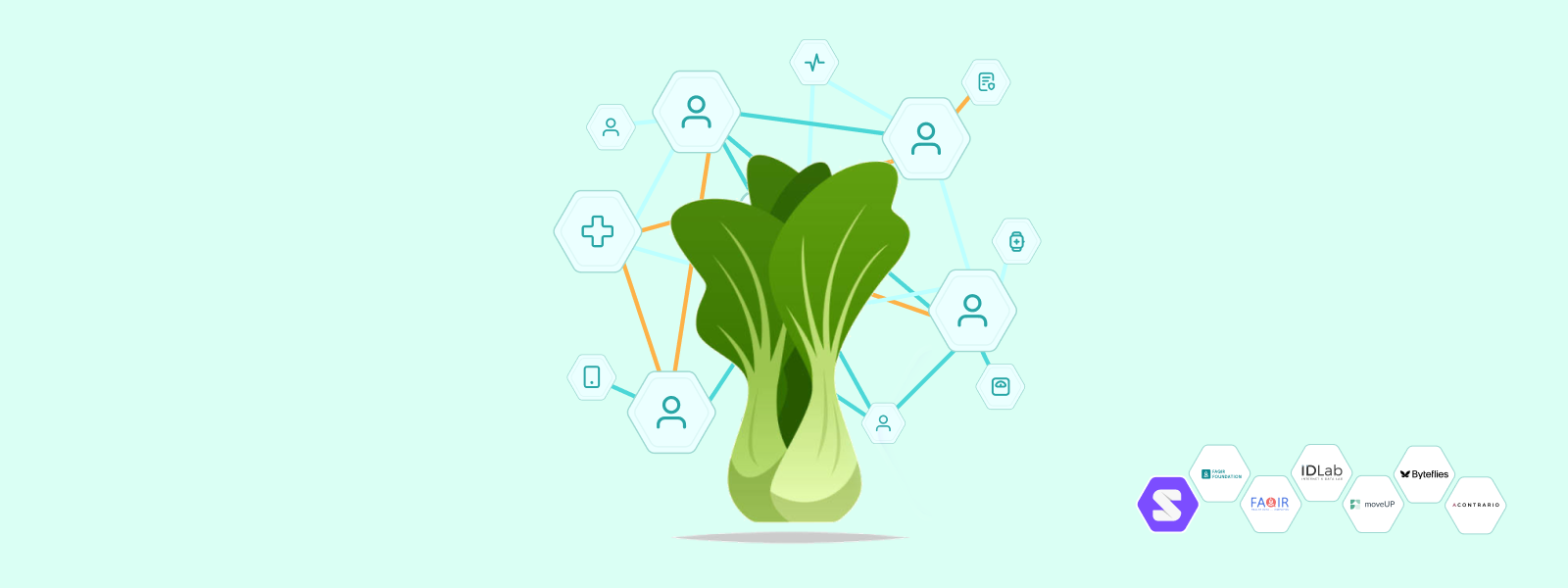
Bariatric care relies on a wide range of data, yet this information is fragmented across organizations and systems. Hospitals, GPs, dietitians, physiotherapists, psychologists, and various mobile applications each collect and store their own pieces of the patient record. The result is a dispersed landscape where:
- Data sources vary widely, from clinical systems, mobile apps, wearables, and sensors.-
- Data types range from clinical records and lifestyle information to heart rate, weight, medical images, and follow-up photos.
- Data formats span structured data, binary files, self-reported entries, and real-time sensor streams.
- Regulation tightly restricts how health data can be reused or shared beyond its initial purpose.
This fragmentation blocks the creation of a coherent bariatric patient profile. As a result:
- Clinicians and researchers cannot access a comprehensive view of a patient’s bariatric progress.
- Diagnostic quality, treatment outcomes, and population-level bariatric research are limited.
- Patients feel less empowered about their health and face cumbersome processes to exchange information between providers.
The PACSOI project (a two-year imec.icon research project, started Q3 2024) addresses this need for holistic, secure, and patient-controlled health data management, and demonstrates this for a bariatric use case. PACSOI focuses on interoperability and standardization of clinical data, both for primary use (i.e., for healthcare professionals to provide correct care for their patient) and for secondary use (i.e., for research, quality monitoring, population health management, policy-making, and other analyses that rely on aggregated clinical data). This interoperability research encompasses:
- Semantics, i.e., making sure data is interpreted uniformly across stakeholders.
- Technology, i.e., making sure data exchange is uniform across applications.
- Legislation, i.e., making sure data usage is in line with regulation.
The Bariatric Care Use Case
A bariatric surgery patient’s standardized electronic health data (or EHR) is enriched with interoperable context data, from various sources (e.g., daily weighings on a smart scale, and self-declared answers to in-app Patient-Reported Outcomes or PROMs). The patient is empowered to give time-bound access to parts of these data points with different stakeholders: weighings are shared with a dietitian, anonimized PROM answers are shared with health researchers. Healthcare professionals get more detailed insights in their patients outside of their EHR, health researchers can more easily analyze larger datasets, and regulators reuse anonymised, verifiable audit trails to check legal compliance.
Solution
For this use case, patient-controlled pods serve as user-centred storage hubs. Each patient’s pod aggregates data from multiple sources, maps it to common data models, and generates tailored views that the patient can choose to share at their discretion. Special care is taken into account that legislation is duely followed.
This use case extends the following Trustflows principles to demonstrate how patient-centric data spaces can be realised in practice:
- The framework is interoperable, on multiple layers (currently aligned with the 2017 European Interoperability Framework):
- Semantically, by building and (re)using common data models using Semantic Web technologies such as RDFS, OWL, and SHACL to represent data models, RML, FnO, and SPARQL to represent data transformations, and ODRL to represent policies.
- Technically, by using established and emerging protocols such as OIDC for authentication, OAuth and UMA for authorization, and S3 and GraphQL for data exchange.
- Legally, by establishing active policies with regulations such as GDPR.
- Organizationally, by establishing a governing actor (FAQIR Foundation) for the ecosystem.
- The framework is compliant, see the legal interoperability layer in the point above.
- The framework is trusted by end-users, by using patient-controlled pods as user-centred storage hubs.
This use case commits to the following data architecture:
- The framework is designed from write to read
- Data is written by existing systems into a storage component, using kvasir as server storage implementation. Kvasir provides a slices concept, which generates derived query endpoints based on subgraphs of the total data.
- On top of these slices, aggregators are deployed that create even more derived views. By integrating incremunica as streaming query result updating query engine, these derived views are continuously kept in sync every time something is written to original kvasir instance
- The framework separates storage from authorization
- UMA is used to separate the authorization server from the storage component
Conclusion
PACSOI demonstrates a patient-centric, decentralized approach to healthcare data management for a bariatric case use case. Key capabilities highlighted by PACSOI that apply directly to this use case include:
- Conversion of clinical, lifestyle, and sensor data into Linked Data for integrating diverse health data into a unified, actionable framework.
- Patient-controlled consent and governance so individuals decide which clinicians, researchers, or care coaches may access each record stored in their pods.
- Users can share their data with only the attributes needed for a given purpose, supporting strict data minimisation and GDPR compliance.
- Privacy-preserving analytics and scalable, federated queries that let researchers and policymakers reuse secondary health data without centralising sensitive records.
- Write-to-read pipeline preserving semantics, provenance, and compliance.
- A proof-of-concept for bariatric care that integrates data from 12 sources for 200 patients to coordinate bariatric surgery decisions and personalised lifestyle interventions.
PACSOI
The PACSOI project is a two-year imec.icon research project (started Q3 2024) to address the need for holistic, secure, and patient-controlled health data management. PACSOI brings together secure storage and integration specialists (FAQIR Institute and FAQIR Foundation), digital health companies (Byteflie, MoveUp), legal experts (Acontrario), and three leading research groups (IDLab KNoWS, IDLab DISCOVER, and IDLab PREDICT). A diverse user committee provides guidance, real-world data, and use case validation.
References / Further Technical Details
This use case is detailed in Tackling the Write-to-Read Web of Data with Trustflows, the first project in which we coined the term “Trustflows” while initially implementing PACSOI’s Solid-based architecture.
The PACSOI project page gives an overview of architecture and consortium